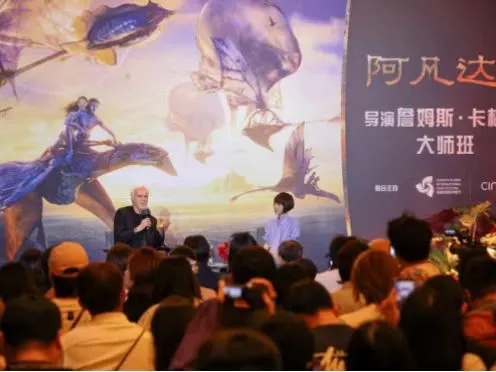






On December 9, the 7th Hainan Island International Film Festival (HIIFF) Masterclass hosted a special event with legendary director James Cameron gracing the occasion. Hosted by renowned presenter and media personality Chen Luyu, the event shared the spiritual core and technological explorations of the Avatar franchise with the audience, as well as Cameron's reflections on and commitment to filmmaking in an era of rapidly changing viewing habits.

"The themes explored in Avatar remain consistent"
Before the event began, Director Cameron greeted the audience with the iconic Na'vi greeting "I see you" from the Avatar franchise. He noted that it has been 10 years since he started writing the screenplay for Avatar 3, and 8 years since the film went into production. "Unfortunately, during this time, our relationship with the world and the environment as human beings has not improved. Even now, hatred and violence continue to occur everywhere in the world. Therefore, the themes of how people perceive one another, connect with each other, and live in harmony with nature persist as consistently as before."
Cameron believes that, rather than focusing on the differences of a specific civilization or language itself, Avatar explores those enduring values that remain constant across different eras and civilizations, such as the human condition, family bonds, courage, and the responsibilities one should bear for one's family and community (often referred to as "tribe" in the films). These timeless topics are universal commonalities found across all nations and civilizations.
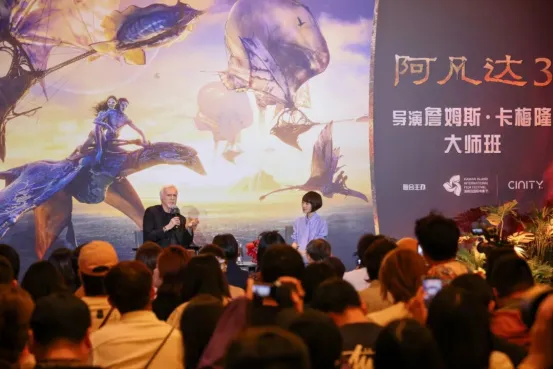
On the one hand, this is because Avatar is a global project spanning a very long period of time. "We know that the success of the first Avatar was global, ranking first at the box office in many markets. For example, it achieved tremendous success in China, yet we neither had Chinese actors nor explored Chinese topics; instead, it explored the things we collectively care about—humanity, human emotions, how we face the identities we are given, and how we integrate with our families and society."
On the other hand, this universality also stems from a certain responsibility that the Avatar franchise has bestowed upon itself. Cameron stated: "A very important mission of Avatar is to emphasize the commonalities among us humans, and to emphasize how our ultimate needs converge despite taking different paths. This is not a choice we make for the moment, but one we will uphold over the long term. We don't want to chase trends or so-called 'popular issues,' because cultural trends are always fleeting, but our essential human attributes do not change."
"Nature is far richer than our imagination"
Beyond being a film director, James Cameron's other widely known identity is that of a pioneering practitioner in deep-sea exploration. In 2012, Cameron successfully descended into the Mariana Trench, reaching the deepest ocean region on Earth alone. He stated that prior to this, he had already accumulated thousands of hours of dive time, and during multiple dives, he experienced nature's unimaginable creativity: "The ocean is a place full of color and vitality. Every time I dive underwater, I can see marine life I have never seen before; some have only been recorded once or twice previously, while others are appearing before humans for the very first time."
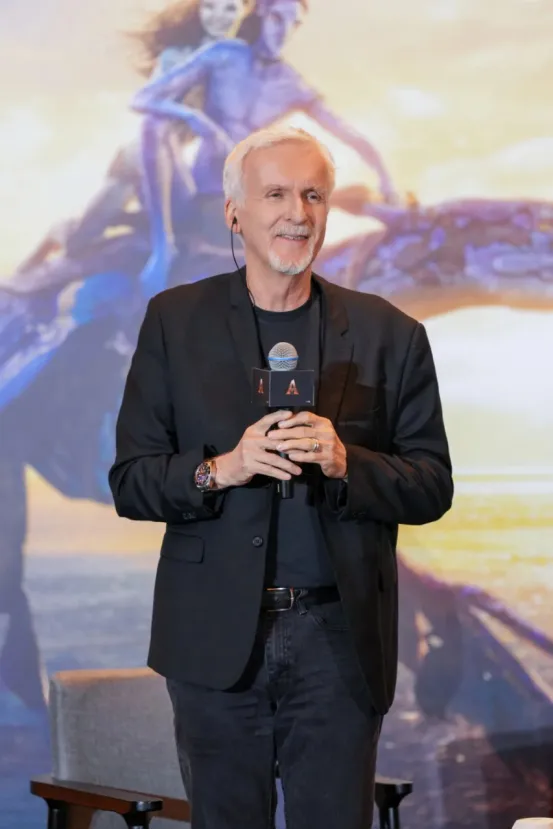
This concern for nature has also directly fed back into the creation of the Avatar franchise. In the films, the ecosystem of the planet Pandora is composed of a diverse array of creatures. "During the creative process, we 'designed' many creatures for Pandora, and the prototypes for many of them came from the creatures I saw during my deep-sea explorations. I always feel that no matter how boundless our imagination may be, nature's imagination is always much richer than ours."
The Evolution of Film: New Technologies Make Acting More Natural
As one of the most groundbreaking explorers and appliers of filmmaking technology, James Cameron expressed his validation of the path of technological breakthroughs in the Avatar franchise. He stated, "Before shooting Avatar 2 began, we spent almost five years and a massive amount of money to completely overhaul our production technology. This was highly innovative work, and from Avatar 2 to Avatar 3, our technology has advanced further." Cameron believes that the latest developments in motion capture technology allow actors to perform in a more natural state: "I tell the actors, you don't need to deliberately exaggerate just because you are filming; your acting should be as close to nature as possible, and our technology will capture the subtle changes in your body and expressions like a microscope, even details you are not aware of yourself. From the actors' perspective, their feeling is that they can act more authentically and truthfully; they can fully immerse themselves in their roles, allowing these characters to interact with each other as they would in reality, rather than deliberately 'acting' for the audience."
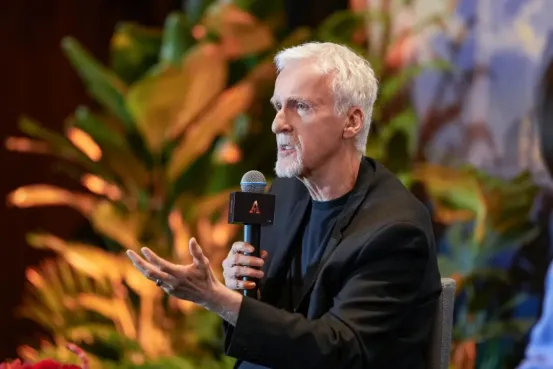
Cameron stated that the innovations in the motion capture technology used in Avatar 3 and Avatar 2 are too numerous to count, but the most important among them is that it is a filming technology that serves the purest form of cinematic acting, which ultimately makes it the secret weapon of the Avatar franchise: "Because it allows the audience and the characters to look each other in the eye at a close distance, we can see the characters' expressions, see their humor, pain, and love. We don't just see them speaking with their mouths; we see their eyes. I think this greatly closes the distance between the audience and the characters, much closer than we have ever been able to achieve before."
The Constants of Film: Maintaining Focus in a Fragmented Era
Despite the rapid development of technology, Cameron firmly believes that the core mission of cinema and movie theaters has not changed, but rather has been entrusted with an even more important task. He believes that in an era where people have grown accustomed to fragmenting their attention, the movie theater represents an active choice to focus. "We don't just watch short videos; even our daily lives have become 'short videos.' So, how do we counter this trend? This is when we need movie theaters. You leave your home, get in the car, buy a ticket, and arrive at the cinema; you have already broken the rules that society takes for granted. Through your own choice, you allow yourself to focus on and immersively experience the story unfolding on that screen. In the theater, your viewing experience is far deeper and richer: your senses are enhanced, especially when watching a 3D movie, more areas of your brain are engaged. You see things you cannot see anywhere else, along with the details of those things."

Even more importantly, film will continue to play its vital role as a life "simulator," a role that can only be fulfilled through movie theaters. "People ask me, why spend money to go to a theater and experience other people's emotions? My answer is that before pilots conduct actual flights, they first train with simulators. And film is the 'simulator' of life; it simulates the various things that might happen in our lives: joy, love, sorrow, loss, death. For all these human experiences, we can step into a theater and go through a simulation. We will derive some feelings from it, and more importantly, we can confirm that we still possess the capacity to feel. This better prepares us mentally to face the things that might truly happen in our own lives."
"And this experience cannot be obtained outside of a movie theater," Cameron said.
Related Articles