




Golden Coconut Main Forum: Focusing on Free Trade Port Opportunities, Jointly Seeking New Drivers for Film Industry Development
HIIFF Hainan Island International Film Festival
December 4, 2025 23:45 Hainan
On December 4, the 7th Hainan Island International Film Festival (HIIFF) Golden Coconut Main Forum, themed "High-Quality Development of Chinese Cinema: Free Trade Port Opportunities and New Drivers for Film Industry Development," was held in Sanya, Hainan Province.
Wang Bin, Member of the Standing Committee of the Hainan Provincial Party Committee and Head of the Publicity Department, and Rani Ittara, Assistant Permanent Secretary of the Thai Ministry of Culture, delivered speeches at the forum. Chen Jiyang, Executive Deputy Director of the Publicity Department of the Hainan Provincial Party Committee and Director of the Provincial Film Bureau, Zhou Chunhua, Member of the Standing Committee of the Sanya Municipal Party Committee and Head of the Publicity Department, along with other leaders from the central government, Hainan Province, and Sanya City, as well as foreign guests including Shin Yong-jun, Consul General of the Royal Thai Consulate-General in Guangzhou, and representatives from the publicity departments of some provinces and municipalities, attended the forum.
Fu Ruoqing, Party Secretary and Chairman of China Film Group Corporation, Sun Zhonghuai, Vice President of Tencent and Chairman of Tencent Online Video, Gao Chunfang, Founder of the Paris Chinese Film Festival, and Li Jie, President of Damai Entertainment, delivered keynote speeches.
At the forum, Sun Xianghui, an expert enjoying the Special Allowance of the State Council, on behalf of the China Film Art Research Center, released the "Report on the Economic Development of Chinese Cinema (2025)." Chen Jiyang, Executive Deputy Director of the Publicity Department of the Hainan Provincial Party Committee and Director of the Provincial Film Bureau, promoted policies related to Hainan's film and television industry and released the upgraded "Hainan Shoot·Shoot Hainan" one-stop digital service platform. Guests including Dong Runnian, director, screenwriter, and executive producer; Li Yaping, well-known domestic presenter and producer, and CEO of Aimei Film & TV; Marco Müller, renowned film producer, scholar, curator, and President of the Jury for the Competition Section of the 7th HIIFF Golden Coconut Awards; Huang Qunfei, Member of the Party Committee and Deputy General Manager of Huaxia Film Distribution Co., Ltd.; Zhang Qinkun, Secretary-General of the Tencent Research Institute and Doctor of Law; and Huangfu Yichuan, Researcher at the China Film Art Research Center and President and Editor-in-Chief of Contemporary Cinema magazine, explored new paths for the development of the Chinese film industry against the backdrop of the construction of the Hainan Free Trade Port through a roundtable forum.

Focusing on Free Trade Port Advantages, Deepening International Cooperation, and Creating a New Highland for the Film Industry
On December 18 this year, the Hainan Free Trade Port will officially launch island-wide customs closure operations. At the forum, Wang Bin stated that the island-wide customs closure operations of the Hainan Free Trade Port is a landmark measure for China's unwavering expansion of high-level opening-up and the promotion of building an open world economy. Free trade port policies can provide tangible support for the film and television industry in terms of taxation, talent, import and export of equipment, and capital flow.
"Preferential policies such as the 'dual 15%' corporate income tax and individual income tax, the cap on individual income tax for high-end talent, and zero tariffs on equipment imports can effectively reduce industry costs and create conditions for high-quality production and international cooperation of Chinese cinema," Wang Bin expressed. He looks forward to filmmakers jointly exploring a new chapter in film development, opening new versions of industrial cooperation in Hainan, and contributing to the development of socialist culture and the building of a film powerhouse.
This year marks the 50th anniversary of the establishment of diplomatic relations between China and Thailand. Rani Ittara, Assistant Permanent Secretary of the Thai Ministry of Culture, shared Thailand's experience in developing its film industry. She stated that cooperation between Thailand and China in the film field has become an important pillar of bilateral relations, and the Memorandum of Understanding on Film Cooperation signed by the two countries in 2023 laid a solid foundation for co-production, film festival exchanges, and talent development.
"Thailand produces no fewer than 780 film and television works annually, many of which perform strongly in both domestic and international markets." Rani Ittara introduced new incentive measures launched by Thailand to attract international productions, including increasing the cash rebate ratio from 20% to 30% and providing a 20% expense rebate for animation, CGI, and post-production.
Rani Ittara
Keynote Speeches: Facing Opportunities and Challenges, Exploring New Paths for High-Quality Development
Data shows that the annual box office and audience numbers of the Chinese film market in 2025 have both exceeded the same period last year, presenting a steady and progressing growth trend. As of the end of October, the annual box office contribution ratio of domestic animated films reached 45.1%, which also indicates profound changes in audience preferences and content formats. At the forum, the guests also focused their discussions on the current opportunities and challenges facing the Chinese film industry.
Fu Ruoqing, Party Secretary and Chairman of China Film Group Corporation, stated in his speech titled "Gathering the Power of Light and Shadow, Co-painting a Blue Prospect" that cinema carries the cultural memory and spiritual pursuit of a nation, and is an important symbol of a country's cultural soft power. He proposed that against the backdrop of the free trade port construction where "the time has come and the momentum has formed," the film industry must accomplish three major missions: first, to deeply cultivate the regional and cultural genes of "ocean culture" and "tropical ecology," deeply integrating international vision with localized expression to create a "Hainan narrative" with global recognition; second, to promote scientific and technological innovation, utilize the policy advantages of the free trade port to build an industry highland, and demonstrate the global leading position of Chinese film technology by taking the CINITY LED projection technology independently developed by China Film as an example of "changing lanes to overtake"; third, to establish a communication paradigm, build a cultural hub radiating to the "Global South," and enhance Hainan's international cultural influence by seizing opportunities such as landing the China premiere of Avatar 3 in Sanya.
"AI is bringing about a redistribution of creative power in the film and television industry, and film and television creation is poised to welcome a new Renaissance." Sun Zhonghuai, Vice President of Tencent and Chairman of Tencent Online Video, systematically explained the profound transformation of content production methods in the AI era during his keynote speech. As generative AI gradually evolves from a "toy" to a "tool" and comprehensively integrates into every aspect of the film industry, the threshold for creation will be further lowered, driving a renaissance in themes, ideas, aesthetics, and the entire industrial ecosystem. He predicted that the next 12 months will be a crucial window for the emergence of AI feature films. Tencent Video has made deep strategic layouts in both AI-empowered traditional workflows and the exploration of "AI-native" film and television. "Being able to witness the Renaissance of the film industry is the fortune of our times. The most beautiful human experience is the process of moving from uncertainty to certainty." Sun Zhonghuai stated that for Tencent Video, this is also a new starting point. He sincerely invited artists to join hands with Tencent Video to jointly promote the deep integration and application of AIGC in the film and television field, and to explore the brand-new frontiers of the industry's future.
Gao Chunfang, founder of the China Film Festival in Paris, France, drawing on her years of experience in promoting Chinese cinema, emphasized that professional dubbing and translation is the core link for Chinese cinema to go global. She pointed out that current artificial intelligence still has obvious limitations in film and television translation, unable to accurately convey the emotions, contexts, and cultural nuances in dialogue. Using her own practical experience of participating in the translation of over 160 films as an example, Gao Chunfang explained that high-quality subtitle translation must balance "fidelity, fluency, and brevity," which cannot be achieved without the meticulous crafting of professional talents. She called on the Chinese film and television industry to attach greater importance to investment in translation, improve the translation budget mechanism, and focus on international promotional strategies and material adaptation, thereby allowing the world to not only understand but also truly fall in love with Chinese cinema.
"Strategizing for young creative talents means strategizing for the future of Chinese cinema." Li Jie, President of Damai Entertainment, pointed out at the forum that the current film market is shifting from an "attention economy" to an "emotional resonance economy," and must rely on a new generation of creators who possess aesthetic height, technical capabilities, industrial thinking, and commercial vision, to activate tradition with innovation and respond to the era with their works. He focused on introducing the "Haina International Young Directors Development Plan," which aims to systematically cultivate young film talents, and emphasized that while the essence of cinema will not be replaced, narrative forms must continue to evolve. Li Jie believes that, relying on its policy vitality and open environment, the Hainan Free Trade Port is becoming an important pivot for international young filmmakers to settle and create. "We hope that through the 'Haina Plan,' more future-oriented creators will grow into the architects of the Chinese film ecosystem."
Li Jie
Release of Annual Industry Report Helps Cultural and Creative Industries Bear Fruit
At the forum, the Research Report on the Economic Development of Chinese Cinema (2025) (hereinafter referred to as the Report) was released, which is the first annual industry report in China focusing on the "systemic impact of the film economy" from the perspective of industrial economics.
As the general lead of the Report, Sun Xianghui introduced that this annual report on the film economy is based on the concept that "structural analysis is more important than simple summary," focusing on explaining the operational logic and patterns of change in the Chinese film economy at the levels of supply, channels, demand, and derivatives.
"The report not only answers 'what the film economy is,' but also answers 'where the contradictions of the Chinese film economic system lie, where the growth lies, and where the breakthrough lies,' clarifying facts, structures, trends, and directions." Sun Xianghui stated, "We hope to rediscover, create, and define the value of cinema from the perspective of a broad historical development process and the national economic system."
The Report provides a comprehensive analysis of the Chinese film industry through chapters including "Background and Problem Statement of Film Economic Development Research," "Film Industrial Organization," "Film Industrial Structure," "Film Industrial Policy," "Film Industrial Layout," "Film Industrial Innovation," and "Prospects for the Economic Development of Chinese Cinema."
In the Report, the film economic map is depicted in the shape of a tree, rooted in the traditional film industry, and providing nutrients for the manufacturing, service, and commercial sectors, helping the entire cultural and creative industry bear abundant fruit. Sun Xianghui introduced: "In the past, we focused on box office revenue because that was all we measured. However, in the era of the film economy, we must not only pay attention to the excavation of content creation and the existing stock of screenings, but also place greater emphasis on exploring new forms of audio-visual entertainment products, as well as the cultural and artistic value represented by film IPs, to better activate and empower other industries, and promote the incremental expansion of cinema."
As of November 30, the annual box office for domestic films has reached 40.39 billion yuan, which is 6.95 billion yuan higher than the total domestic film box office for last year. The contribution ratio of the annual domestic film box office has reached 83.8%, and the currently hit film Zootopia 2 has also achieved better results in China than in the North American market. Sun Xianghui believes that the Chinese film economy still possesses the most massive, mature, and emotionally resonant cultural consumption infrastructure domestically. "We believe that in the future, as new industrial cycle mechanisms continue to form and reorganize, the Chinese film economy is fully capable of breaking through cycles, breaking through obstacles, and breaking through the failure of past experience, achieving a new cycle amidst systemic reshaping, value reconstruction, IP traction, long-tail empowerment, digital-intelligent enablement, and scenario renewal."
Roundtable Forum: Seeking Breakthroughs and Discussing Hainan's Future
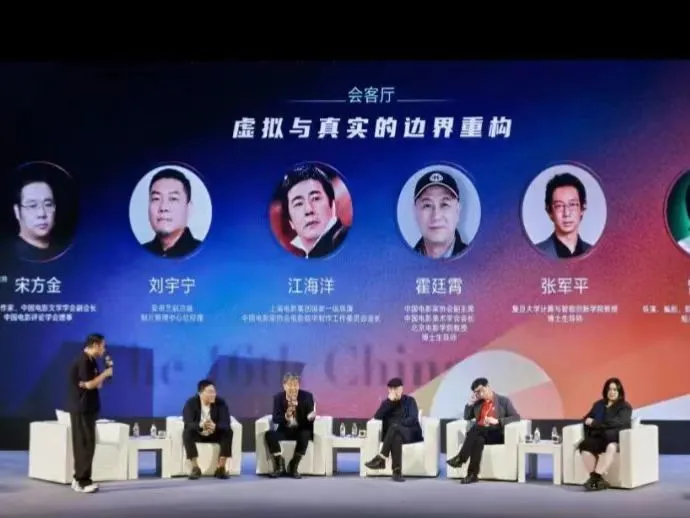
The roundtable dialogue session was hosted by well-known host Zhang Likun, inviting six guests including Dong Runnian, Li Yaping, Marco Müller, Huang Qunfei, Zhang Qinkun, and Huangfu Yichuan to conduct in-depth discussions around three major topics: "Content Innovation and Global Narrative," "International Collaboration and Industrial Upgrading," and "Institutional Opening-up and Technological Empowerment," offering advice and strategies for Chinese cinema to attract audiences, break through bottlenecks, and leverage the development of the Hainan Free Trade Port.
Roundtable Forum Venue
Core Focus: How to Bring Audiences Back to Theaters?
The discussion opened with a direct address to industry concerns: how to attract audiences, especially young audiences, into cinemas? Director Dong Runnian frankly stated that while the overall quality of films has improved, the "time cost" of going out to watch a movie and the diversification of entertainment options pose real challenges. He believes the breakthrough lies in films not only evoking emotional resonance but also striving to become "cultural phenomena," making cinemas the places where these phenomena are witnessed; at the same time, creators must stand among the audience rather than opposite them, truly engaging in a dialogue with the audience through their works.
Starting from the original intention of the audience, producer Li Yaping called on creators to first forget their identity as producers and return to being pure audience members to evaluate their works. "If the environment is full of challenges, can we become optimistic creators to solve problems and find precious connections with the audience? This is exactly what we need to do."
Zhang Qinkun, Secretary-General of the Tencent Research Institute, believes that the Chinese film and television industry has entered a new stage of high-quality development led by a "premium strategy." A number of outstanding Chinese film and television works are going global, meeting the viewing habits of overseas audiences with diverse themes and a youthful narrative voice.
Huangfu Yichuan, Researcher at the China Film Art Research Center, stated that the key to building a healthy Chinese film ecosystem lies in achieving a dynamic and open balance. On the one hand, it is necessary to always adhere to the cultural original intention of content is king; on the other hand, it is essential to provide fertile soil for diverse creation through technological empowerment, industrial integration, and standardized regulation.
Huangfu Yichuan
Embracing Change: AI is a Challenge but Also "Creative Democratization"
Facing the wave of AI technology, guests unanimously agreed that it should be actively embraced. Director Dong Runnian pointed out that AI brings "creative democratization," which will lower thresholds, shorten the distance between creation and audiences, and predicted that industrial-grade AI feature films may appear within three years, urging creators to take immediate action and engage in experimentation. Li Yaping shared from a production perspective how AI significantly reduces production costs and the price of trial and error. Huang Qunfei believed that AI will reshape the entire industry chain, making it possible for individuals to produce films, and that cinemas must enhance immersive experiences and social attributes to meet the challenges. Zhang Qinkun explained that as long as AI-generated content reflects human creativity, it is protected by copyright law, clearing obstacles for technological application.
Huang Qunfei
Going Global and Staying Local: Hainan Narratives from a Global Perspective
Regarding the global expansion of Chinese cinema, Huang Qunfei pointed out the need to mitigate cultural discount with a narrative strategy of "Chinese elements + universal human values" and to establish a "one country, one policy" global distribution adaptation system. Marco Müller suggested that Chinese cinema's "going global" need not focus too heavily on the North American market and Hollywood, and could draw more lessons from the "Global South," especially Southeast Asia. The forum further explored the construction of "Hainan narratives"; Huangfu Yichuan elaborated on its unique DNA: the embrace of a maritime China, the "spirit of venturing to the sea," the integration of diverse cultures, and the sense of the future endowed by the Free Trade Port. The key lies in translating local stories into a universally understood cinematic language, transforming Hainan from a sightseeing destination into a "storyteller" of Chinese stories. Marco Müller placed high hopes on the positioning of the Hainan Island International Film Festival (HIIFF) as a cultural bridge, optimistic about it becoming a hub connecting the film cultures of the "Global South." Huang Qunfei expected Hainan, leveraging the Free Trade Port policies, to build itself into a new pivot for Chinese filmmakers to connect with the global market, capital, and talent.
Marco Müller
Leveraging Policy Advantages to Build a New Film Industry Ecosystem
Chen Jiyang, Executive Deputy Minister of the Publicity Department of the Hainan Provincial Party Committee and Director of the Provincial Film Bureau, systematically introduced the "Four Reductions, One Enhancement, One Pioneer" film and television policy system for the Hainan Free Trade Port at the forum. This involves reducing corporate costs, market thresholds, individual tax burdens, and cross-border barriers; enhancing service capacity after customs closure operations; and taking the lead in laying out an innovative intellectual property ecosystem. He introduced that Hainan provides enterprises with multiple dividends, including the nation's lowest 15% income tax, "zero tariffs" on imported equipment, and individual tax incentives for high-end talent, while striving to create an environment of free and convenient cross-border flow of funds and personnel. With the customs closure operation of the entire island imminent, these policy advantages will further translate into stable and predictable institutional competitiveness. The upgraded "Hainan Shoot·Shoot Hainan" one-stop digital service platform was also officially launched at the event, aiming to turn the policy highland into accessible convenience for global filmmakers. Chen Jiyang extended a sincere invitation to global filmmakers, looking forward to them riding the waves with their scripts and dreams, and jointly writing cinematic legends on this open and vibrant land of Hainan.
The Golden Coconut Main Forum of the 7th Hainan Island International Film Festival concluded successfully amidst the convergence of wisdom. Co-organized by the Communication University of China, this forum, grounded in the historical milestone of the Hainan Free Trade Port's customs closure operations, gathered cutting-edge industry insights. From constructing "Hainan narratives" to embracing AI transformation, and from nurturing young talent to expanding global outreach, it systematically explored new drivers for the high-quality development of Chinese cinema. The attending guests unanimously agreed that Hainan, with its unique policy advantages and open DNA, is becoming a crucial pivot for innovation and international cooperation in the film industry. The consensus and pathways formed at the forum not only contribute cinematic strength to the construction of the Hainan Free Trade Port but also inject Hainan's momentum into building a film powerhouse, fully demonstrating the unique value of the Golden Coconut Forum as a film industry think tank for the Free Trade Port. Looking ahead, Hainan will continue to use cinema as a medium, joining hands with global filmmakers to jointly write cinematic legends of the new era on this open and vibrant land.