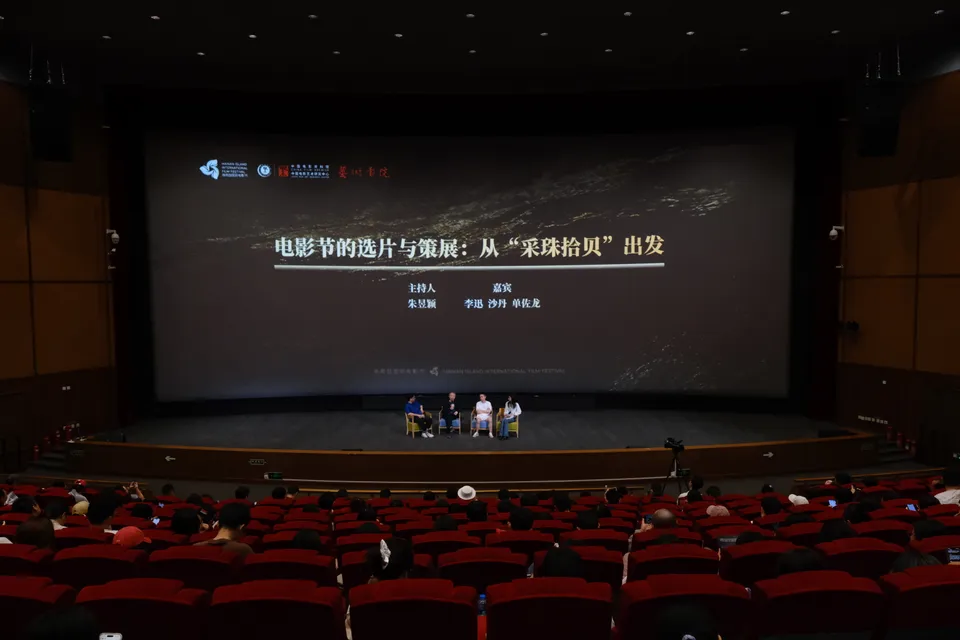







Since its launch, the "Travel with Cinema" Global Classic Film Screening event at the 7th Hainan Island International Film Festival (HIIFF) has maintained its momentum, with audience enthusiasm continuing to rise.
On November 8, at Wanda Cinema (Haikou Riyue Plaza IMAX), we watched the 2025 latest work *Sirât* directed by Olivier Laxade with over 100 audience members, bringing them a viewing experience that returns to the purity of audiovisual art.
In the film, through the imagery of "Sirât" (path), Director Laxade not only presents a pursuit in the material world but also metaphorizes a spiritual transformation and sublimation. During the post-screening Q&A, Mr. Ma Kai, Head of the Film Art Department at the South China Sea Film College, engaged in an in-depth discussion with the audience, jointly exploring the visual philosophy and emotional core of this highly discussed work of the year. The questions and sharing between the audience and the guest were not merely a clash of viewpoints, but a resonance of souls. The sparks of thought made the shock and lingering impact of the film echo for a long time.

Host
Liang Yafei

Founder of "Floating Island", curator of the Hainan New Wave Youth Film Exhibition.
Guest Speaker
Ma Kai

Head of the Film Art Department at the South China Sea Film College, member of the Hainan Film and Television Association, member of the China Colleges and Universities Film and Television Society, and expert of the Hainan Provincial Film Bureau Film Review Committee.
Sirât Post-Screening Review
Liang Yafei
I would first like to ask Mr. Ma Kai to share his thoughts on the audiovisual language of this film. Are there any visual designs that left a deep impression on you?
Ma Kai
I feel that this film must be watched in a cinema. The visual and auditory impact was incredibly strong on me; this is a work that truly returns to audiovisual art, truly returning to the essence of cinema.
The director's creation has a strong sense of the present. First, he treats all media as visual itself; sound and visuals are no longer tools for storytelling, but become the protagonists. Second, it subverts the concept of the traditional road movie. This subversion is reflected in: first, the destination of this film, the "party", is inherently nihilistic. Traditional road movies go from point A to point B with a clear destination; second, the film's narrative presents a fractured state. After the little boy falls off the cliff, the action of "searching" abruptly stops, turning into an inward process of coexisting with sound and music.
In terms of specific visuals, the desert scenes were shot on 16mm film, and that graininess is tangible, which reflects the director's desire to return audiovisuals to the original texture of visual art.
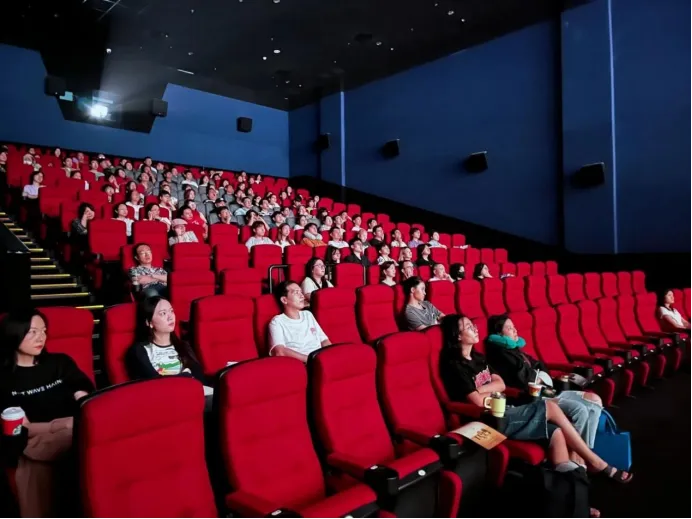
Screening Venue
Liang Yafei
Today's experience was like a deep breath; the film simultaneously connected human insignificance and the vastness of nature. The director once said he wanted to achieve a realm of "seeing music, hearing images," allowing narrative and melody to dissolve into pure texture. In the contemporary cinematic context that pursues narrative pacing, is this attempt to let the materiality of sound and image dominate highly avant-garde and rebellious?
Ma Kai
The avant-garde nature of this film lies not in flashy techniques, but in its courageous redirection of the "highway" defined by commerce and the market onto a "desert path". I believe this is a sober correction and a brave return.
In the era of social media, much audiovisual content is filled with information and piles up dialogue, neglecting the audiovisual itself. However, *Sirât* brings us back to sensory feelings. Whether it is the low-frequency rumble or the film grain, it pulls us back to the level of feeling—this is a return from narrative to existence. Cinema is an audiovisual art, not something reliant on the piling up of language.

Post-Screening Q&A Venue
Liang Yafei
A part of this film's completeness is handed over to the audience. It abandons traditional narrative, and later completely leads the audience into a feeling state of "falling". In this, music is crucial. The sound design was handled by electronic musician Kangding Ray, and the director hoped the music would complete a journey from fierce techno music to ambient music, ultimately moving towards the disintegration of sound. Mr. Ma, do you feel that at a certain moment, the sound is no longer background, but has become a character, even altering the texture of the imagery?
Ma Kai
In this work, music transforms from a scoring tool into the subject. It takes time to adjust at the beginning, but when the characters twist to the music on the desert for the first time, I even subconsciously wanted to join them, achieving a resonance. The music played in the opening rave party is Techno, which originated in 1980s Detroit, attempting to create a "sound of the future" that belongs to neither white nor black people. Understanding this, one can comprehend the music in the film: the strong Techno at the opening represents an "upward" posture seeking a way out; while the disappearance of music later, leaving only the buzzing vibration that requires bodily sensation, turns it into a spiritual journey from outward release to inward collection, from listening to songs to feeling the heartbeat.
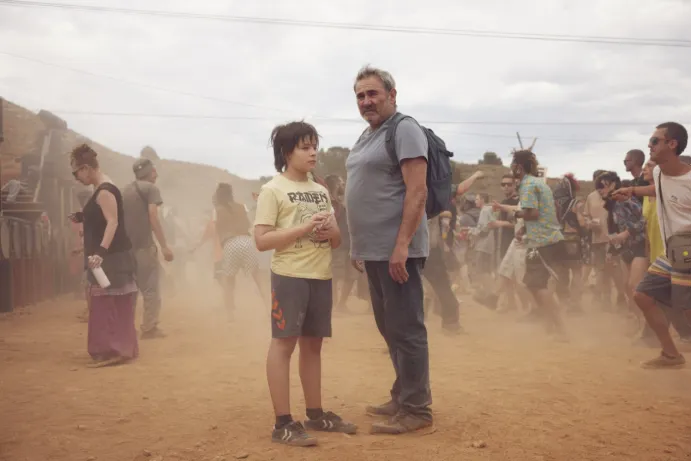
Sirât Stills
Audience Q&A
Audience 1
The scene of everyone dancing at the beginning reminded me of Bakhtin's theory of "carnival". How should one interpret the changes in "carnival" before and after? The void space of the desert is like a heterotopia in literature; can the change in music be seen as a fantastic element?
Ma Kai
First, the film constructs an "aesthetics of ruins"—the ruins of a party, the ruins of a military site, and even the entire desert as the ruins of human civilization. The camera is static and gazing, rather than exhibiting, which creates an inescapable sense of exhaustion amidst the wreckage of modernity. Second, light plays a crucial role here; the film makes extensive use of natural light, such as the scorching sun and moonlight, which serve as visual tools for this aesthetics of ruins. Finally, environmental elements like the sound of the wind and explosions become reflections of the characters' inner states. For instance, landmines are no longer an external danger, but an inner instability within people, ready to explode at any moment; the broadcasts, queues, and dust closely resemble the noise and order of our modern society. The environment becomes a mirror reflecting the characters' anxiety and displacement.

Post-Screening Q&A
Audience Member 2
Do you feel that the theatrical experience, especially the music, is the core of what constitutes a "cinematic feel"? Finally, why are there many good films today, yet so little public discussion? Is it the impact of short videos on the human spiritual world?
Ma Kai
In an era where cinema is becoming semanticized and fragmented, it is highly valuable to have nearly a hundred audience members come to the theater today to support art cinema. Sirât is precisely an act of rebellion; by amplifying the music and sound effects, it makes the medium itself the subject, telling us that cinema is an audiovisual art that must return to the theatrical experience.
Audience Member 3
I feel the film is divided by the scene of setting up speakers and dancing in the desert. Before this, there are more characters, and various situations can be resolved through human connections, which seems to suggest there is an endpoint; after this dividing line, people start being toyed with by fate and controlled by the impermanence of the world. Especially when crossing the minefield, I found that the more I thought, the more uncomfortable and useless it felt, until the male lead casts aside his thoughts and simply walks through. I also have another interpretation of this dividing line: musically, the first half has a strong pulse, which disappears afterwards, creating a sense of falling into nothingness, which might be connected to the male lead's emotions at that time.
Ma Kai
Thank you for your sharing; that was exceptionally well said. It confirms my own feeling: in the first half of the film, everyone's salvation is directed "upward" and outward; after the little boy falls off the cliff, the focus shifts completely "inward," returning to one's own footsteps. It subverts the concept of the "path"—the path is not in the distance, but right within the ruins beneath one's feet.

Screening Venue
Emotional Resonance, Intellectual Exchange
The screening and post-screening Q&A of Sirât not only allowed the audience to appreciate the pioneering exploration of contemporary cinematic audiovisual language, but also created a space for deep reflection and emotional resonance. The enthusiastic participation and in-depth discussions from the audience fully prove the market's craving for works possessing artistic courage and intellectual depth.
The Hainan Island International Film Festival (HIIFF) has always been committed to selecting high-quality global films for audiences and building a bridge of dialogue between creators and audiences. The successful hosting of this event has injected more confidence into our future screening curation. We will continue to look forward to bringing more diverse and cutting-edge film works in future events, and hosting deeper and more open conversational dialogues, making HIIFF a warm haven where the art of cinema and the souls of audiences intersect, and continuously guiding everyone along this surprising "desert path" to discover the most authentic and stunning charm of cinema.